



Adaptive Resilience Intelligence
Saskatchewan-built. Designed for organizations everywhere.
Saskatchewan-built. Designed for organizations everywhere.
© 2026 Prairnova Technologies Inc.
Saskatchewan, Canada
It's 7:40 a.m. in a prairie town of nine thousand people, and the entire IT department (one person, maybe two if budget allowed a co-op student this year) is staring at 340 unread alerts from three different security tools. A firewall log flagged something odd overnight. The backup job for the water treatment SCADA network ran twelve minutes long. Someone in finance clicked a link in an email that looked exactly like a CRA notice. None of these may be a real incident. All of them need a human to look.
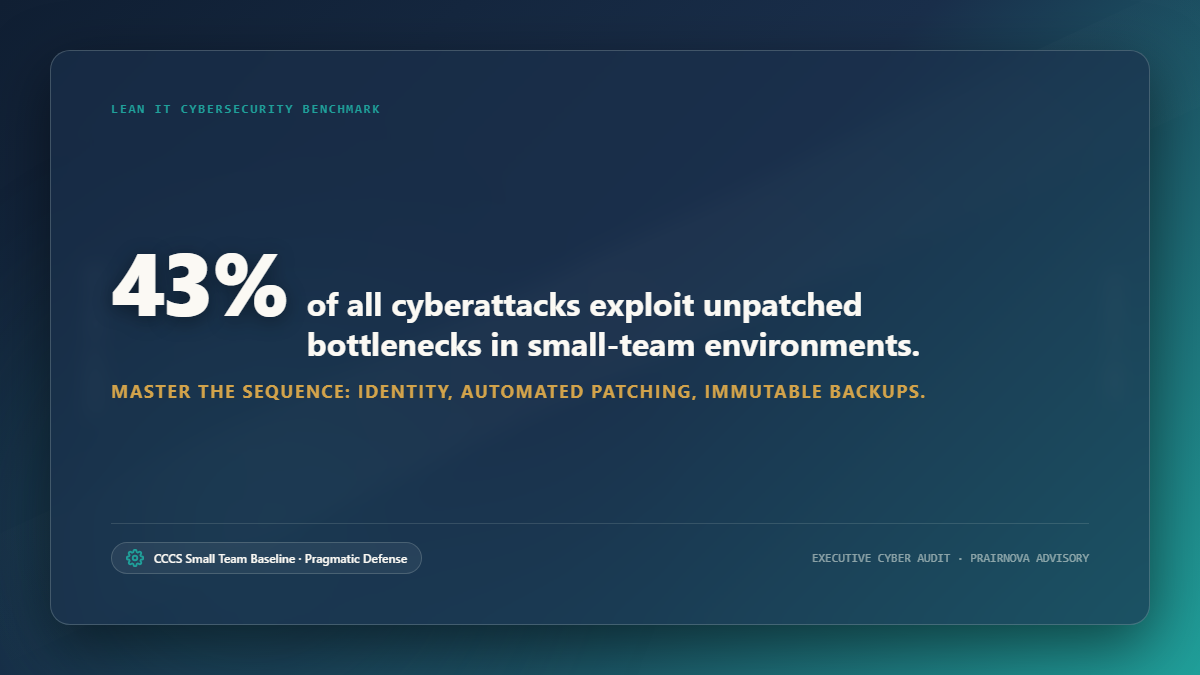
This is the daily reality for most small and mid-sized Canadian organizations, and it's especially acute in municipal government. According to the Canadian Centre for Cyber Security (CCCS), 43% of all cyberattacks now target small businesses, many of which have no dedicated cybersecurity staff at all. Municipal World has documented that many Canadian municipalities run IT on less than 1% of total operating budget. You're not failing at cybersecurity because you're careless. You're failing because the math doesn't work: finite people, finite hours, infinite attack surface.
The fix isn't more tools. It's sequencing. When you can't do everything, you have to know exactly what to do first, second, and never.
CIRA's Cybersecurity for Small Business research makes a point that doesn't get enough attention: the volume of alerts itself is a threat vector. When a two-person team is drowning in low-priority notifications, the one alert that actually matters (a credential being used from an unfamiliar country at 3 a.m.) gets lost in the noise. Attackers count on this. They don't need to be sophisticated if your team is too exhausted to tell signal from noise.
This is where a lot of well-meaning small IT shops go wrong. They buy another tool to catch what the last tool missed, and now they have four dashboards instead of one problem solved. (The instinct is understandable. It's also how budgets get consumed without reducing actual risk.) The better move is consolidating visibility and tuning down the noise before adding anything new. An honest cybersecurity assessment, one that actually maps what you have against what attackers are using right now, usually reveals that half your alert volume is configuration debt, not genuine threat activity.
If you strip away the vendor noise, CCCS baseline guidance and Microsoft's own security research converge on a short list of controls that prevent the overwhelming majority of real-world incidents. None of these require a large team. All of them require discipline.
Multi-factor authentication, everywhere it can go. Microsoft's security research has found that MFA blocks over 99.9% of automated account compromise attempts. That single number should drive budget decisions more than almost anything else in this article. If you have to choose between an expensive next-generation firewall upgrade and finishing MFA rollout across email, VPN, and admin accounts, finish the MFA rollout. It's cheaper, faster, and statistically more impactful.
Backups that are actually tested, not just scheduled. A backup job that runs every night and has never been test-restored isn't a backup plan. It's a hope. CIRA's research on small business cybersecurity specifically flags this gap: organizations assume recovery works because the job shows green, and then discover during a ransomware event that the backup was corrupted, incomplete, or also encrypted because it sat on the same network segment as production.
Patch management with a real cadence. You don't need to patch everything the day it drops. You need a known schedule (weekly for critical systems, monthly for the rest) and a way to prove it happened, because insurers and auditors will ask.
Phishing-resistant awareness training. The Verizon Data Breach Investigations Report has consistently found phishing to be the most common initial access vector in breaches. A fifteen-minute quarterly session with real examples from your own inbox does more than an annual compliance video nobody remembers by February.
Notice what's missing from this list: elaborate threat hunting platforms, bespoke SOC build-outs, anything requiring a team you don't have. That's intentional. Those things matter eventually. They don't matter first.
Bill C-26, the federal legislation establishing the Critical Cyber Systems Protection Act, technically applies to federally regulated critical infrastructure sectors like telecom, finance, and energy. Most municipalities aren't directly captured by it. But the principles inside it, risk management obligations, incident reporting timelines, and supply chain scrutiny, are quietly becoming the baseline expectation everywhere, including how insurers and provincial regulators evaluate you.
Provincial privacy law is where the exposure is more immediate. Saskatchewan's LAFOIP, along with Alberta's and BC's PIPA and Quebec's Law 25, impose real breach notification obligations on public bodies. If a ransomware event exposes resident data, you have a legal clock running, not just a technical cleanup job. That means your incident response plan can't just be a technical runbook. It needs to name who calls legal counsel, who drafts the notification, and how fast that decision chain moves. CCCS's guidance for small and medium organizations is explicit on this point: a basic incident response plan needs communication protocols and data recovery steps written down before you need them, not improvised during the event.
Most small teams don't have this written. (If you're reading this and realize you don't either, you're in the majority, not the exception.) It doesn't need to be fifty pages. It needs to answer five questions clearly: who gets called first, who has authority to take systems offline, where the clean backups live, who talks to residents and media, and when the municipality's legal obligations to report kick in.
The following is a illustrative sequencing model, not a prescription, meant to show how a lean team might stage this work across a budget cycle instead of trying to solve everything in one fiscal year.
In the first phase, the focus is visibility and quick wins: inventory every system with access to resident or employee data, finish MFA on all privileged and email accounts, and run one test restore from backup to confirm recovery actually works.
In the second phase, attention shifts to the written incident response plan and tabletop testing it with council or senior leadership, so the first time anyone sees the plan isn't during a live ransomware event.
In the third phase, the team tightens access controls and tunes down alert volume, removing stale permissions and consolidating monitoring so that what remains in the queue is actually worth looking at. (If a department manager complains that their team can't access a shared drive they haven't touched in three years, that's a far easier conversation than explaining a breach caused by that same unused access.)
In the fourth phase, the organization formalizes cyber insurance requirements and supply chain checks on third-party vendors, since insurers are increasingly tying premiums directly to whether baseline controls like MFA and tested backups are actually in place, not just claimed on a form.
This sequencing matters because it respects the constraint lean teams actually face: not technical ignorance, but time. Doing four things properly over a year beats attempting twelve things badly in a quarter.
Part of prioritization is explicit deprioritization. A few things that can reasonably wait if you're a one- or two-person shop: advanced threat intelligence feeds (you'll drown in data you can't act on), custom-built security dashboards (standardize on what your existing tools already give you), and exotic zero-trust architecture rebuilds before the basics above are solid. These aren't bad ideas. They're expensive ideas that only pay off once foundational hygiene is in place.
This is also where an objective decision-support layer earns its keep. instead of a human team trying to manually triage hundreds of alerts and guess at priority, a capability like ARI (Adaptive Resilience Intelligence) is built to translate raw cyber evidence, alerts, configuration gaps, control coverage, into a clear, ranked set of priorities and a verifiable trend over time. It doesn't replace the judgment of your team. It gives a stretched team the clarity to act on the handful of things that actually move the needle, instead of reacting to everything with equal urgency.
IBM's Cost of a Data Breach Report put the average cost of a breach for Canadian organizations at CAD 7.05 million. Few municipalities will face a breach at that exact scale, but the ratio matters more than the raw number: recovery, legal exposure, notification costs, and reputational damage routinely dwarf what proper sequencing of basic controls would have cost. Cyber resilience services exist precisely to help lean teams close that gap without needing to hire a security team they can't afford to carry.
You don't need a bigger team to be meaningfully more secure this year. You need a shorter list, done properly, in the right order. Strong authentication first. Tested recovery second. A written, rehearsed response plan third. Everything else, including the advanced incident response capabilities and deeper assessments that come later, builds on that foundation, not around it.
Let's explore what's possible — together.
