



Adaptive Resilience Intelligence
Saskatchewan-built. Designed for organizations everywhere.
Saskatchewan-built. Designed for organizations everywhere.
© 2026 Prairnova Technologies Inc.
Saskatchewan, Canada
It usually starts small. A municipal clerk is behind on correspondence, pastes a resident complaint letter into ChatGPT to draft a reply, and doesn't think twice about the address and phone number sitting in that same paragraph. A non-profit program coordinator uploads a grant application, personal details included, into an AI tool just to summarize it faster. Nobody flagged either move as risky. Nobody had ever told them it was. There was no policy to break.
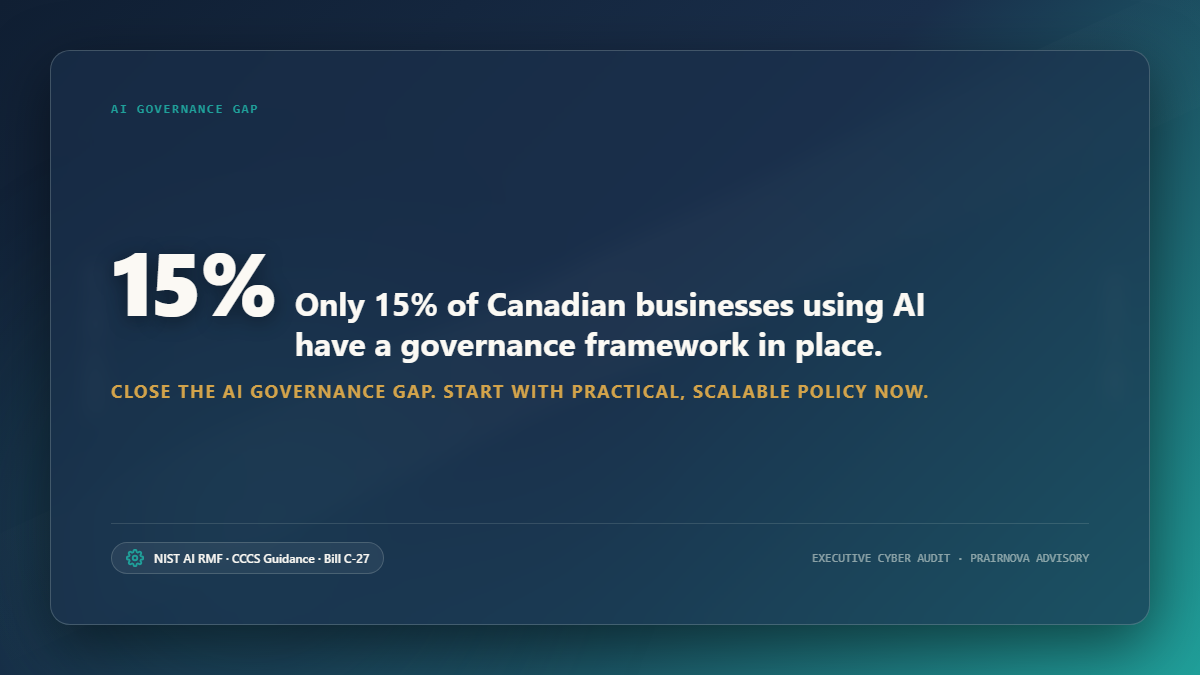
That's the reality in most lean-IT organizations across the Prairies right now. AI adoption has outpaced AI governance by a wide margin, and almost nobody planned it that way. The Canadian Centre for Policy Alternatives (CCPA) found that roughly 60% of Canadian businesses are exploring or actively using AI tools, but only about 15% have a dedicated governance framework in place. That gap isn't a failure of discipline. It's a resourcing problem, plain and simple. A two-person IT shop running a municipality or a regional non-profit doesn't have a risk and compliance department sitting idle, waiting to write policy. They're patching servers, fielding help desk tickets, and trying to keep the lights on. (Writing AI policy tends to fall somewhere below "fix the printer" on that list.)
So the real question isn't whether an organization needs AI governance. It's what the smallest, most defensible starting point looks like for a team that actually has to sustain it past month one.
There's a version of AI governance that looks great in a slide deck and dies the moment it reaches a front-line manager's inbox. Dense. Legalistic. Written by committee, filed away, never referenced again. That's not governance. That's a liability shield with no operational teeth.
The NIST AI Risk Management Framework (AI RMF 1.0) gets cited constantly, and for good reason: it doesn't tell you exactly what controls to buy. It gives you four functions, Govern, Map, Measure, Manage, and lets you scale the depth to your organization's size and risk exposure. For a lean team, that flexibility matters more than the framework's pedigree. Nobody here is trying to satisfy an auditor from a Fortune 500 company. The real goal is making sure the AI tools staff are already using don't quietly leak personal information, make a biased call about a resident, or expose the organization during a Bill C-26 or Bill C-27 compliance review down the road.
Governance, at this scale, really comes down to four unglamorous things: knowing what AI tools are in use, knowing what data they touch, knowing who's accountable when something goes wrong, and having a documented (even if short) answer ready when someone asks. That's it. That's the whole foundation.
PwC Canada's guidance on responsible AI makes a point that gets missed constantly: you can't govern what you haven't counted. Before drafting a single policy clause, the more useful exercise is a plain inventory. What AI tools are staff actually using, officially or not? Copilot in Microsoft 365. ChatGPT in a browser tab nobody mentioned. An AI feature baked quietly into a finance or case management platform. A chatbot vendor added to the township website last year without IT ever being looped in.
This inventory doesn't need to be exhaustive on day one. It needs to be honest. (If a department has been quietly using an AI transcription tool for council meeting minutes for eight months, that's useful information, not a reason to panic.) The goal is visibility, not punishment. Staff who feel safe admitting what they're using will hand over a far more accurate picture than staff who think disclosure gets them written up.
Once the list exists, sort it by what kind of data each tool touches: public information, internal operational data, or personal and sensitive information covered under provincial privacy legislation like FOIP or LAFOIP. That single sort does more governance work than most formal frameworks combined, because it points straight at where the real exposure sits.
Not every AI tool deserves the same scrutiny. A grammar-checking plugin and an AI system that helps triage building permit applications aren't the same risk category. Treating them identically wastes the limited hours a lean team actually has to spend.
Canada's evolving regulatory direction helps clarify priorities here instead of complicating them. Bill C-27, through the proposed Artificial Intelligence and Data Act (AIDA), is built around a risk-based approach: systems that affect human rights, safety, or significant life outcomes draw heavier obligations than low-stakes productivity tools. AIDA's specific regulations are still being finalized, but the underlying logic is worth adopting now anyway. For each tool in the inventory, ask whether it influences a decision about a person (hiring, benefits eligibility, service access, discipline), whether it touches sensitive personal information, and whether an error could cause real harm, financial, legal, or reputational, to a resident or client.
Anything that lands in that upper tier gets a documented owner, a human-review step before any output is acted on, and a note on how data flows through the tool. Everything else gets lighter-touch treatment: acceptable-use reminders, a reporting line if something looks off, periodic review and nothing heavier. This tiering alone solves most of the resourcing problem. It stops a lean team from trying to govern a grammar checker with the same rigor as an eligibility screening tool, which is a waste nobody can afford.
One of the more practical pieces of guidance to come out of the Canadian Centre for Cyber Security (CCCS) is the recommendation to integrate AI security considerations into existing cybersecurity frameworks instead of standing up a separate AI compliance program. That's sound architecture, not a shortcut. If your organization already has baseline controls around access management, data classification, vendor risk review, and incident response (per the CCCS baseline controls), AI governance slots into those same processes instead of duplicating them.
Practically, that means your vendor risk review process now needs AI-specific questions before a new tool gets approved: where the data is processed and stored, whether the vendor trains its models on your organization's inputs, whether you can turn that off, and whether the vendor publishes its own security and compliance posture. Your incident response plan should name "an AI tool produced or exposed something it shouldn't have" as an explicit scenario, with a named person responsible for triage. (Finding out which staff member owns that call is a much easier conversation during a Tuesday planning meeting than during an actual incident.) Your access management policy should extend to who can enable new AI features inside tools you already license, particularly Copilot, since seat-level AI features often ship enabled by default inside Microsoft 365 tenants.
This is really the core of what a proper AI Enablement & Governance approach looks like for a resource-constrained organization. Not a separate bureaucracy. A set of deliberate extensions to controls you're already maintaining. Copilot readiness and governance, in particular, deserves its own look before broad rollout, because the gap between a well-scoped deployment and an accidental oversharing incident usually comes down to permission hygiene that predates the AI tool entirely. Permissions don't fix themselves.
The Office of the Privacy Commissioner of Ontario's guidance on AI and privacy keeps circling back to three principles that translate directly into operational practice: transparency, accountability, and data minimization. Transparency means residents and clients have some reasonable way of knowing when AI is involved in a decision that affects them. Accountability means a named human, not "the system," is responsible for that decision's outcome. Data minimization means AI tools only get fed the data they actually need, not an entire case file because pasting the whole thing felt faster.
That last point is where most incidents actually originate. It's rarely a sophisticated AI failure. It's an employee pasting more context than necessary into a chatbot because trimming it down felt like extra work. (And nobody ever trained them that it mattered.) A short, specific acceptable-use guideline, reviewed with staff instead of just emailed and forgotten, closes most of that gap without requiring a legal department to weigh in.
For context, here's an illustrative model, not a prescription, for how a lean municipal or non-profit IT function might sequence this work over roughly six months, assuming no dedicated governance budget exists yet.
The early weeks usually boil down to triage: a short survey to department heads, a review of what's enabled inside your Microsoft 365 or Google Workspace tenant, and a look at any AI features already quietly live in finance, HR, or case management platforms. By month two, that inventory gets risk-tiered using the human-impact and sensitive-data questions above, and a one-page acceptable-use guideline goes out, written in plain language instead of legal boilerplate (nobody reads the boilerplate anyway). Months three and four are where the heavy lift turns procedural: vendor risk review questions get updated to include AI-specific items, and any high-tier systems get a named accountable owner plus a documented human-review step. The back half of the year is where it gets tested for real. By months five and six, the organization runs a short tabletop exercise: what happens if an AI tool exposes personal information, who gets called first, and what gets communicated to affected residents or clients under existing privacy obligations.
None of this requires new headcount. It requires about a day a month of focused attention and a willingness to treat AI governance as an extension of existing security hygiene instead of a brand-new discipline bolted on top. That's the whole trick.
The hardest part of this work isn't technical. It's prioritization under noise. A lean IT lead juggling patch cycles, help desk tickets, and a council presentation doesn't have time to manually weigh every AI tool request against every regulatory signal coming out of Ottawa or a provincial privacy office. That's exactly the kind of decision paralysis platforms like Adaptive Resilience Intelligence (ARI) are built to cut through: translating scattered evidence, your asset inventory, your risk tiers, your existing control posture, into a clear, defensible set of priorities, then tracking whether those priorities actually move the needle on risk over time instead of just sitting in a binder collecting dust. It's not a replacement for judgment. It's a way to stop re-deriving that judgment from scratch every quarter.
Nobody expects a two-person IT team at a rural municipality to produce an AIDA-grade compliance program this fiscal year. Regulators don't expect that either; the risk-based approach embedded in Bill C-27 is specifically designed to scale obligations to actual impact. What's expected, and what's genuinely achievable, is a documented inventory, a sensible risk tier, a short acceptable-use guideline staff have actually seen, and an extension of existing security controls to cover AI-specific exposure.
That's not compliance theatre. That's the actual foundation responsible AI adoption gets built on, and it sits well within reach of a lean team willing to spend a handful of focused hours getting it down on paper.
Let's explore what's possible — together.
